


Let’s Talk Turkey…
go.ncsu.edu/readext?1103754
en Español / em Português
El inglés es el idioma de control de esta página. En la medida en que haya algún conflicto entre la traducción al inglés y la traducción, el inglés prevalece.
Al hacer clic en el enlace de traducción se activa un servicio de traducción gratuito para convertir la página al español. Al igual que con cualquier traducción por Internet, la conversión no es sensible al contexto y puede que no traduzca el texto en su significado original. NC State Extension no garantiza la exactitud del texto traducido. Por favor, tenga en cuenta que algunas aplicaciones y/o servicios pueden no funcionar como se espera cuando se traducen.
Português
Inglês é o idioma de controle desta página. Na medida que haja algum conflito entre o texto original em Inglês e a tradução, o Inglês prevalece.
Ao clicar no link de tradução, um serviço gratuito de tradução será ativado para converter a página para o Português. Como em qualquer tradução pela internet, a conversão não é sensivel ao contexto e pode não ocorrer a tradução para o significado orginal. O serviço de Extensão da Carolina do Norte (NC State Extension) não garante a exatidão do texto traduzido. Por favor, observe que algumas funções ou serviços podem não funcionar como esperado após a tradução.
English
English is the controlling language of this page. To the extent there is any conflict between the English text and the translation, English controls.
Clicking on the translation link activates a free translation service to convert the page to Spanish. As with any Internet translation, the conversion is not context-sensitive and may not translate the text to its original meaning. NC State Extension does not guarantee the accuracy of the translated text. Please note that some applications and/or services may not function as expected when translated.
Collapse ▲Soon frozen turkeys will be on sale at the grocery store and this is the best buy of the year! Frozen turkeys are traditionally on “the best sale of the year” before Thanksgiving at a huge savings so watch your grocer’s advertised special. If you have room in your freezer consider buying another to enjoy another time of the year, like Christmas or even Easter. A frozen turkey keeps for 12 months if properly wrapped and stored at 0 degrees F.
One of the first questions to ask when selecting a turkey is how many people will you be joining you and this will help you know the size of the turkey you want to purchase. As a general rule, plan on 1 1/2 Pounds of turkey (uncooked) per person. In other words, to feed 12 people, you’d need an 18 pound turkey (12 × 1.5 = 18). This formula will produce generous leftovers but takes in consideration the parts we don’t consume like bones and skin. Another question to consider when selecting a turkey is how will it be cooked as some turkey cooking appliances have size limits.
Food safety is key to avoid any turkey mishaps. All poultry can carry a common type of bacteria known as Salmonella. Properly handling, thawing, cooking and storing your turkey can drastically decrease the risk of causing a food-borne illness. Always wash surfaces and wash your hands before and after handling the turkey…this is true for the outdoor cook as well.
Follow these tips for a succulent and safe turkey this holiday season.
- The most important step is properly thaw the turkey. The best way to thaw your bird is in the refrigerator. You will need 24 hours of thawing time for every 4 to 5 pounds. Be sure to give yourself plenty of time to complete this process before it is time to prepare the turkey. Leave the turkey in the original wrapper and place it in a pan or tray to catch the juices as it thaws in the refrigerator. This will help prevent cross-contamination. It is NEVER safe to thaw turkey or other meat on the counter at room temperature. Cook within 1-2 days after thawing.
Clip this chart from USDA for recommended time for thawing a turkey in the refrigerator:
- 4 to 12 pounds — 1 to 3 days
- 12 to 16 pounds — 3 to 4 days
- 16 to 20 pounds — 4 to 5 days
- 20 to 24 pounds —5 to 6 days
- Do not wash the turkey! Although people wash their turkey in hopes that the water will get rid of bacteria on the skin, this practice is actually dangerous. Bacteria, such as salmonella, cannot be rinsed off with water as it will splash in your sink and to other surrounding surfaces. Only cooking to a proper temperature of 165 degrees F. will destroy bacteria.
- After thawing remove the giblet bag and carefully toss the wrapper. You may roast the giblets with the turkey or boil them to add to dressing or gravy.
- Wash hands, sinks, counters, utensils and platters thoroughly with soap and hot water before and after working with raw turkey.
To Traditionally Oven Roast A Whole Turkey, set the oven temperature no lower than 325 F. It is not safe to cook a turkey for a lengthy time, such as overnight at a very low temperature. This encourages bacterial growth. You may season the turkey at this point. I use only salt and pepper, but herbs like rosemary, thyme, and sage or spicy Cajun seasoning might be your choice. Whatever blend you choose, spread it all over the turkey—on top, underneath, between the body and wings and legs, under the skin, and even in the cavity of the bird. Personally I like to use a turkey oven bag when roasting a turkey following the directions on the box by adding and shaking a little flour in the bag then I place the seasoned turkey in and tie is closed. I set the bagged bird on a shallow baking pan and cut slits in the bag as directed. A turkey bag yields a moist turkey and with no basting required. I then place the bagged seasoned turkey in a pan with 2 inch sides and place in the preheated 350 degree F. oven.
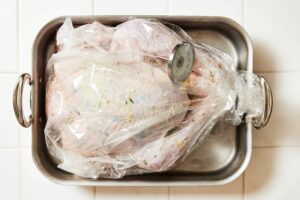
Roasted turkey in oven bag
If you plan to stuff the turkey, do so just before roasting. The internal temperature of the stuffing must also reach 165 degrees F. just like the turkey. I recommend cooking stuffing or dressing in separate casserole as a added measure of food safety and I prefer the crisp top and edges of the dressing when baked in a casserole dish.
You will want to use a meat thermometer to check for doneness. Some turkeys have a pop up red and white plastic thermometer. These are not reliable as the only temperature gauge. They are often late and the resulting turkey is over cooked. The thigh meat (thickest part) should reach 165 F. e. For whole, unstuffed turkeys in oven cooking bags, cook at 350 degrees Fahrenheit. Below is a guide from USDA gives you approximate roasting times. It has a wide range of time but, use it to help you plan your schedule for your busy oven.
- 8-12 lb. turkey: 1 1/2 to 2 hours.
- 12 to 16 lb. turkey: 2 to 2 1/2 hours.
- 16-20 lb. turkey: 2 1/2 to 3 hours.
- 20-24 lb. turkey: 3 to 3 1/2 hours.
Let the turkey rest for 20 minutes after removing it from the oven before cutting it. This will allow the juices to redistribute and keep your bird moist before slicing. Now the oven is available to bake last minute items on your menu like yeast rolls. A large meal is all about timing and so you need to have a plan. Your smart plan might be dividing the menu to other guests coming. I suggest that you communicate that you want them to bring it “ready to eat or ready to heat” as it is a wicked surprise to have your kitchen taken over by someone preparing a recipe from the beginning at your event.=pYou may carve the turkey on a cutting board with a sharp chef knife and arrange it on a platter with white meat and dark meat grouped. Don’t forget to garnish the platter with fresh herbs and fruit just prior to dining as “we eat with our eyes first.” For a more formal setting you may carve the turkey with a carving knife and meat fork at the dining table with the dinner plates stacked asking each person if they wish to have light or dark meat and pass the plate to them.
A Spatchcock Turkey is a faster method to cooking a turkey in your oven. Spatchcock simply means removing the entire backbone and flattening the poultry before cooking. The timing will depend on the size of your turkey, but in the end spatchcocking really speeds up cooking time. This method cooks white meat and dark meat more evenly, meaning no more dry white meat!
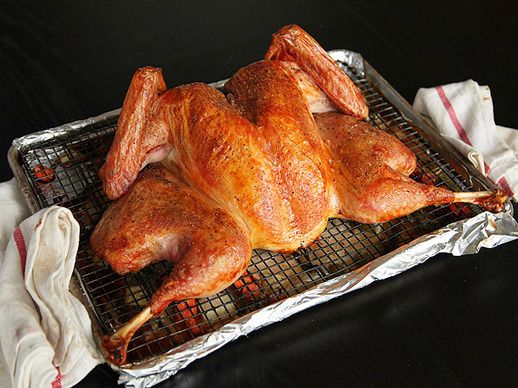
Spatchcock Turkey
How do you Spatchcock a Turkey? To do this place thawed 10-12 lbs. turkey, breast side down, on a cutting board. Remove back bone with poultry shears and cut through ribs on both sides of the backbone. (Save the backbone to cook with the turkey neck to make your gravy.) Turn turkey, breast side up, and using good force, push hard down on the turkey breast. You will hear cracks and notice that the turkey is flatter. Now, the turkey should be able to spread open… you have now “butterflied” the turkey. You should have the legs and wings pushing out sideways (like the bird has been flattened). Line a baking pan with foil and place a rack on top and place the Spatchcock turkey on top. Refrigerate if you are not cooking right away. You may refrigerate overnight.
On the day of cooking, remove turkey from refrigerator. Season with salt, pepper and paprika and other herbs as desired. You may wish to tuck herbs under the skin…seasoning is a personal preference. Preheat oven to 450F. Place uncovered turkey in preheated oven. Cook for 30 minutes. Then, rotate pan by turning halfway around. Cook for another 30 minutes. Check internal temperatures with a meat thermometer. Turkey is completely cooked when joint of the thigh and legs reaches an internal temperature of 165F. If it is not 165F return to oven and cook an extra 20 minutes and re-check temperature. Cook to at least 165F. Immediately cover turkey loosely with aluminum foil and allow to rest for a minimum of 20 minutes. Slice and serve!I
I find carving is much simpler, too, as everything is flat and easier to access. This spatchcock turkey is beautiful and even more so in slices with emphasis on the crispy skin. This oven spatchcock turkey method is complete in about 1 hour 30 minutes for an 11 pound turkey, MUCH less time than roasting a whole turkey. Remember that timing is a guide it is the internal temperature of 165 degrees F minimally that is measure of completion.
Smoking and Frying Turkeys
Other popular cooking methods are smoking and frying turkeys. You will want to follow the manufacturer’s instructions for using these appliances including where to set up the appliance. Because they are often outside it may shift the responsibility for cooking the turkey to an outdoor chef and it frees space in the kitchen. For food safety regardless of the method remember to use an internal instant read thermometer as all poultry must be cooked to a minimum internal temperature of 165 degree F. In general a smoker has a low cooking temperature (minimum 200 degrees F.) for a long time. Smoked turkey has am enhanced smoke flavor and may appear pink when cooked from being smoked.
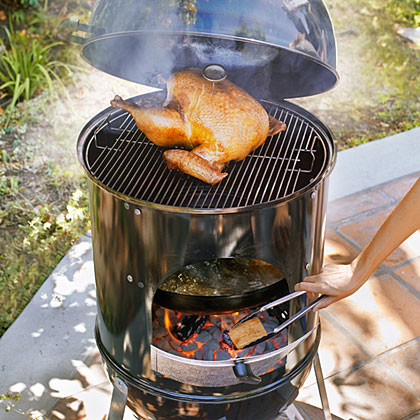
Smoked Turkey
A turkey fryer requires a high cooking temperature for a short time. You always want to start with a thawed turkey. Be sure that there is no ice in the center cavity and drain and dry the turkey with disposable paper towels. Before placing it in the appliance you want to seasoning the turkey inside cavity and outside the turkey with herbs and spices or your choice. Cajun seasoning is very popular choice.
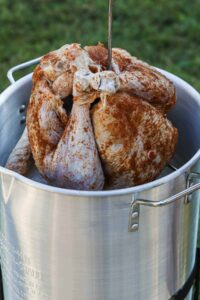
Deep Fried Cajun Turkey
When using a Turkey Fryer is crucial that you select an oil with a low smoking point such as peanut oil. It takes a lot of expensive oil to fry a turkey. Aside from the cost of the fryer you should know that you may purchase a turkey on sale for less than $5 but you may spend $30 on the oil. You can reuse the oil and freezing it will keep it from becoming rancid. The oil may be thawed overnight or a few days at room temperature to use again. When you set up your fryer place it out of traffic area and away from children. As you add oil in the fryer you must account for the oil level that will rise when the turkey is added. You will want to preheat the oil following the manufacturer’s instructions. If there is a lot of water still on the turkey and it is placed in the hot oil will it will spatter, potentially boiling over and could cause a fire and a messy clean up. So be careful to super dry the turkey and be sure to not over fill the oil in the turkey fryer.
Internal temperature of cooked food is important but so is the temperature which food is stored after cooking. To avoid the growth of harmful bacteria that can spoil your leftovers you must handle food safely. The Temperature Danger Zone which harmful bacteria grows fast is between 41ºF and 135ºF. Minimizing time in this range reduces growth of these harmful bacteria. Foods that can support the growth of harmful bacteria should not be left in this temperature range for more than 4 hours. Examples: cooked vegetables, casseroles, pasta and rice; cooked and raw meat, poultry and fish; cut fruits like melons, sliced tomatoes and even leafy greens can spoil. Leftover turkey stored properly In the refrigerator below 41 degrees F. will be good for 3-4 days. Cooked turkey slices can be frozen (at 0 degrees F.) for 3–6 months, but for best quality and flavor, it’s recommended to use them within 3 months.

Turkey Fryer
Remember food safety is key to a yummy meal!
Sources for this article NC Extension Food and Nutrition educational program. For more information about the Foods and Nutrition please contact Louise L. Hinsley, Extension Agent, Family Consumer Science at the Beaufort County Center of N.C. Cooperative Extension, 155 Airport Road, Washington, 252-946-0111.