With ghosts, ghouls, and goblins out and about visiting each house in hopes of getting some treats, dangers can lurk when you least expect it. By staying safe on a dark night, your kiddos will be happier—and might get more candy. Here’s a list of simple actions you can do to bring peace of mind and avoid a real scare.
Preparing for the big night
Pick a light or brightly colored costume: Spooky, dark-colored costumes are hard for others to see. If your child chooses a dark costume, use reflective or glow-in-the-dark tape. You can also add this on to the candy bag to help increase visibility.
Grab the glowsticks: Use these as an accessory—such as a glow stick necklace or bracelet—to help increase visibility to drivers. A flashlight or themed light stick can also be used.
Leave the mask at home: Take a picture of the full costume but leave the mask at home when it’s time for trick-or-treating. Instead, use face paint or non-toxic makeup to complete the look.
Avoid a fall: Getting candy is exciting, and chances are your child is going to run door to door. Help them avoid a fall by choosing a costume that doesn’t drag on the ground.
While You’re Trick-or-Treating
Kids under 12 should always trick-or-treat with adult supervision. If your kids are older and want to go out on their own, map out an agreed-upon route, set a curfew, and make sure that at least one person in the group has a cell phone for emergencies.You may want to venture out in a group, so make sure you stay together. Be sure to stay on well-lit streets and always use the sidewalk. If there isn’t a sidewalk, walk at the edge of the road and in the direction of oncoming traffic.
After the Haul
Inspect the loot: After you’ve conquered the neighborhood, take a look at your child’s candy bag. Look for any treats that are open or have broken packaging and discard them. Also get rid of any homemade items. If you have young children, put away any hard candy or gum that can be a choking hazard.
Remove allergens: If your child has allergies, remove any candy that may cause an allergic reaction. To make sure a child isn’t left out, exchange their candy for something that doesn’t contain allergies, such as an allergen-free treat or a toy.
Take care of your teeth: With increased sugar intake, it’s important to remove bacteria, food, and sugar by brushing those teeth. Sweet treats like candy can cause periodontal (gum) disease and break down the enamel of the tooth, leading to dental cavities. Be extra diligent in making sure your kids are brushing and flossing twice a day to help prevent cavities.
Tip: If you are handing out treats, throw in some fun for kids who have allergies such as Halloween-themed school supplies or trinkets like spider rings or glow sticks.
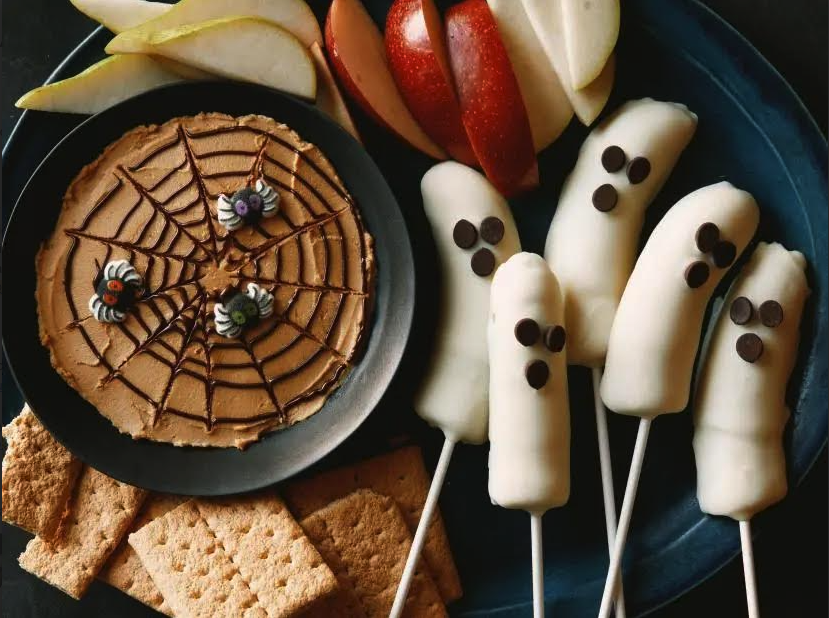
Banana Ghosts with Peanut Butter Dip Yield: 4 to 6 servings
These frozen banana ghosts are a fun Halloween snack that’s also super easy. They’re great with the sweet and creamy peanut butter dip made extra spooky with a spider web piped from melted chocolate. Feel free to add apple and pear slices as well as graham crackers to round out the platter with more dipping options. The ghosts and dip can be made ahead but the dip will firm up when chilled, so be sure remove it from the fridge about 30 minutes before serving. This is a great recipe for the family to make ahead and enjoy the week of Halloween!
Ghosts:
- 4 firm, ripe bananas
- 8 lollipop or ice pop sticks
- 2 cups white chocolate chips
- 2 teaspoons coconut oil
- 24 chocolate chips
Dip:
- 8 ounces cream cheese, at room temperature
- 1/2 cup loosely packed light brown sugar
- 1/2 cup creamy peanut butter (not natural)
- 1/4 cup vanilla Greek yogurt
- 1 teaspoon pure vanilla extract
- 1/4 cup semisweet chocolate chips
- 1 teaspoon coconut oil
- Candy spiders, for decorating, optional
- Special equipment: 8 lollipop or ice pop sticks, a toothpick
Start the ghosts:
- Line a baking sheet with parchment and make room for it in your freezer.
- Peel the bananas and cut in half crosswise, then lengthwise for 8 pieces total.
- Insert 1 stick in the short, flat side of each; arrange on the prepared baking sheet and freeze until solid, about 2 hours.
Meanwhile, make the dip:
- Combine the cream cheese and brown sugar in a food processor; process until light and very smooth, 1 to 2 minutes.
- Scrape down the sides then add the peanut butter, yogurt and vanilla.
- Process, scraping down the sides halfway through, until very light and smooth, 1 to 2 minutes more. Transfer to a serving bowl.
- Combine the semisweet chocolate chips and coconut oil in a small microwave-safe bowl and microwave at 50-percent power in 15 second increments, stirring in between, until melted, about 60 seconds total.
- Transfer to a resealable sandwich bag, twist to close like a pastry bag and snip a small corner. Pipe concentric circles on the surface of the dip.
- Drag a toothpick through the circles, starting from the center and working your way out, to create a spider web design. Add a few candy spiders, if desired.
Finish the ghosts:
- Once the bananas are frozen, combine the white chocolate chips and 2 teaspoons coconut oil in a double boiler or heatproof bowl set over a saucepan of simmering water (do not let the bowl touch the water) and melt, stirring until very smooth, 2 to 3 minutes.
- Hold a frozen banana over the bowl and spoon white chocolate over the top, letting the excess drip back into the bowl.
- Return to the parchment-lined baking sheet and press in 3 chocolate chips, flat-sides up, to make 2 eyes and a mouth.
- Repeat with the remaining bananas and chocolate chips.
- Return to the freezer until the white chocolate is hardened, at least 15 minutes, up to 4 hours.
Sources for this article NC Extension Food and Nutrition educational program. For more information about the Foods and Nutrition please contact Louise L. Hinsley, Extension Agent, Family Consumer Science at the Beaufort County Center of N.C. Cooperative Extension, 155 Airport Road, Washington, 252-946-0111.