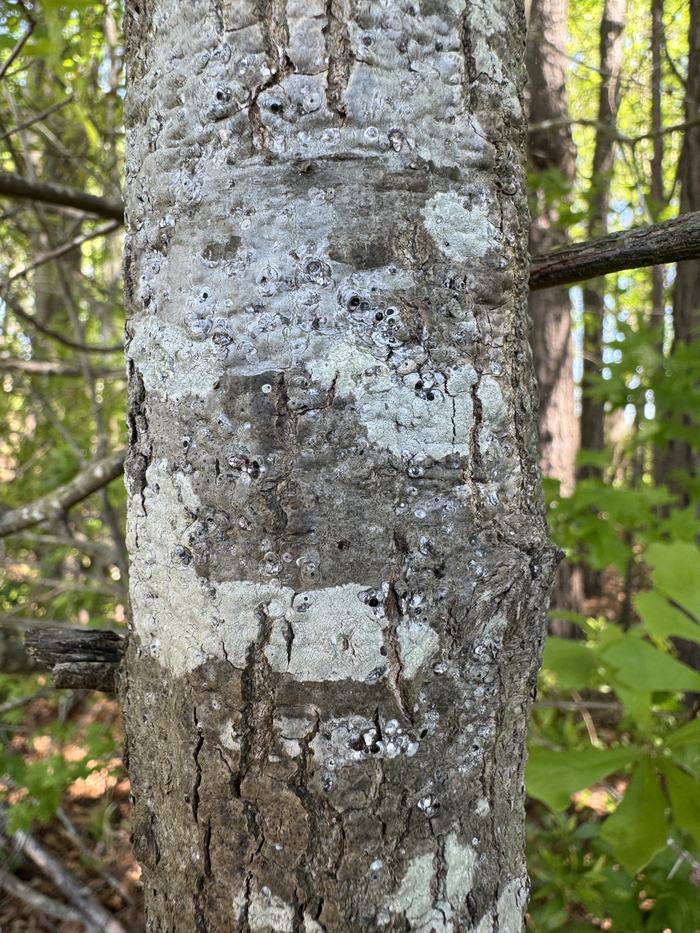
I receive several calls a season about green moss or fungus growing on trees. What is this stuff? Moss does grow on trees within a forest, typically on the Northern side of older trees. This is one of the first things I learned in Boy Scouts when we were learning about orienteering. We also have plenty of fungal issues that can plague trees such as verticillium wilt, anthracnose, and even armillaria root rot. But these aren’t the problem in this case.
We are talking about lichens! Sounds like a mythical creature from a Tolkien novel or the Jim Henson movie The Dark Crystal. These are actually really neat organisms composed of fungi and algae. The two organisms that form the lichens are in a symbiotic relationship in which they both benefit from the other. The algae photosynthesizes food for the fungi which in turn provides structure and protection from the elements. Together they make what we call lichen.
Lichens attach to structures such as homes, fence posts, or even large rocks. These are all things that are immobile for long periods of time or forever in most cases. The same is true for your trees. Think about this, some trees grow extremely slow such as certain cultivars of Japanese maple or dogwoods. I often see lichens on these trees when they are older. When the tree is not growing very fast, it provides a perfect environment for lichens to establish.
These unique organisms are wind dispersed so they can move about and establish nearly anywhere they find a good stationary host. When they establish on our trees though we get worried. However, as mentioned above, the only benefit the lichens get from our trees is a good structures on which to establish. They do not hurt or take away from the tree in any way nor do they cause harm to the trees in any way.
There is however a reason to worry when we see lichens establish upon our trees. Typically they are an indicator that the tree has slowed new growth. Younger trees, depending upon species of course, should grow between 18”- 36” per year. This is considered normal growth. If your young trees are growing less than this it may be cause for some research into the growth characteristics of the tree. It might also be cause for a soil sample to make certain your tree has adequate nutrition.
Often, I find that when lichen is present, the trees have an issue with roots, conductive tissue, or they have slowed due to reaching maturity. In an urban environment, the roots of our trees are often restricted in how they grow. This can be due to restricted space, hardscapes, or even just from being planted to deep. All of these scenarios with the roots can cause the canopy to grow much slower than normal.
Sometimes I find that the trees have been girdled. This can be due to improper staking of the tree, voles, disease, or mechanical damage from mowers and weed trimmers. The conductive tissue is what transports nutrients, water, and carbohydrates up and down the tree. If it is damaged the tree is suffering, the result of which is slow growth or even death of the tree.
Lastly, trees have a life expectancy just like us! Some trees have been around since Jesus walked the face of the Earth and that is pretty cool. I have stood beside some of these trees that are estimated to be a little over 2,000 years old. These trees are protected and have everything they need to stay alive. However, they have plenty of lichen on them because they are mature and not growing much on an annual basis. Some trees are barely three years old and they have lichen on them because for one reason or another, they just aren’t growing. The lichen isn’t killing these trees but it does tell us that something is either wrong with the tree or the tree has just gotten old and stopped growing.
If you are having trouble with growing in your home landscape, call the Extension office to talk to a Master Gardener℠ volunteer on Mondays and Wednesdays from 10:00 to 12:00 at (252)946-0111. Check-out the Beaufort County Master Gardener Facebook page to see helpful gardening tips and see the plant of the week. Extension Master GardenerSM Volunteers will be having their annual vegetable sale this Saturday, April 20th from 9:00 – 11:00, be there early because plants go quick! Until then, Happy Gardening!